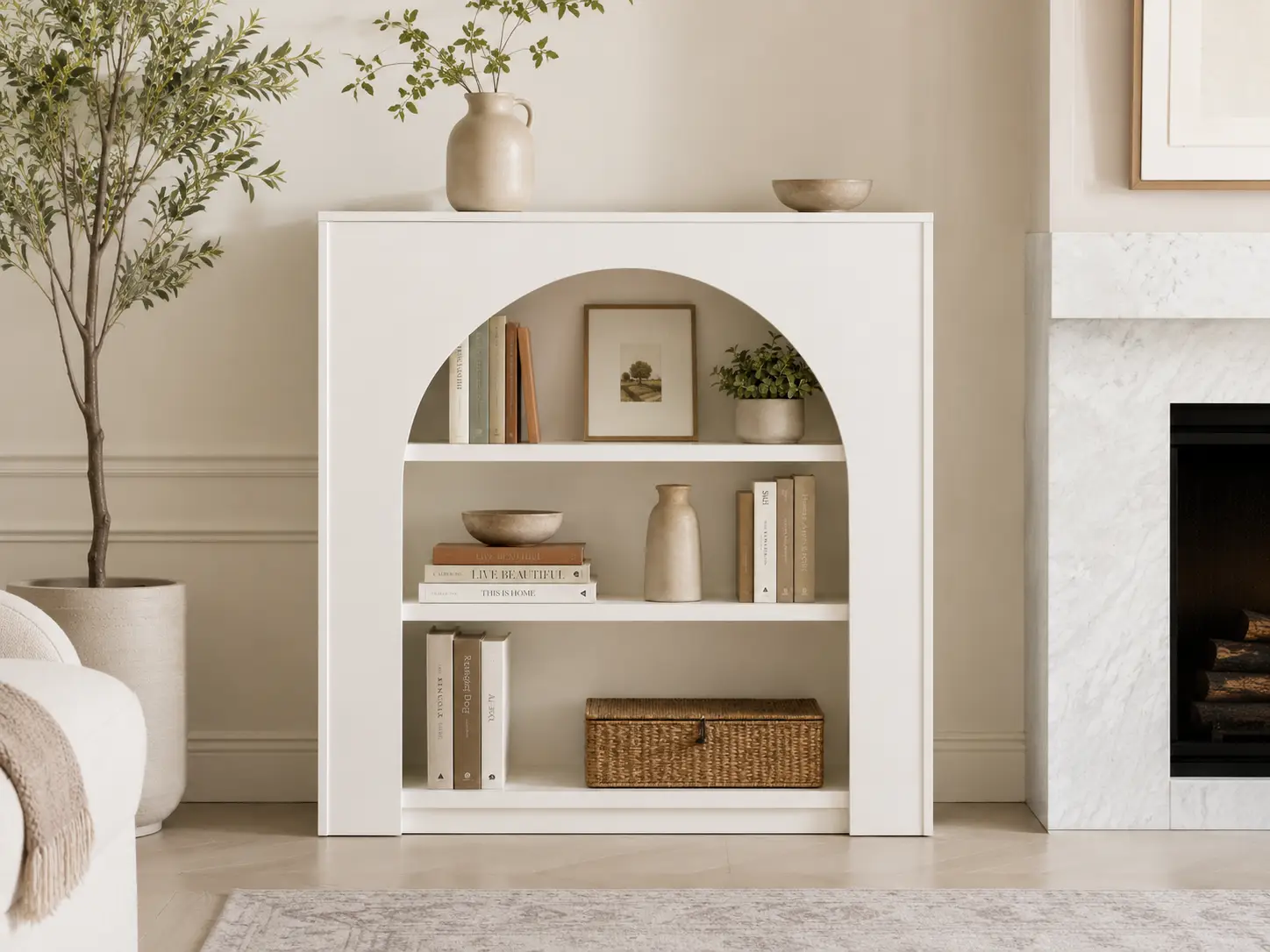
A styled bookshelf isn’t random — it follows a handful of repeatable moves. This annotated diagram breaks down how to style a bookshelf so it looks composed instead of cluttered. Find the numbered markers on the shelf, then read what each one is doing below.
- Mix orientations. Stand some books upright and stack others flat. The horizontal stack breaks up rows of spines and reads as a deliberate pause.
- Leave negative space. Don’t fill every inch. Empty gaps give the eye somewhere to rest and make what’s there feel curated.
- Add greenery. One plant (real or faux) softens all the straight lines and adds life and color.
- Use a riser. Set a small object — a bowl, a box, a sculpture — on top of a flat stack to raise it and vary the heights.
- Vary heights for rhythm. Stagger tall and short groupings across the shelves so your eye moves in a gentle zig-zag, not a flat line.
- Anchor the bottom. Put your heaviest, darkest, or largest pieces low — a basket, big books, a solid object — so the shelf feels grounded.
The Fastest Way to Style a Bookshelf
If you only remember one method: empty the shelf, then rebuild it in three passes. First place the books (some upright, some stacked). Next add height and life — a plant, a leaning frame, a vase. Finally, edit: remove about a fifth of what you added so the shelf can breathe. Working in layers like this is far easier than trying to place everything perfectly the first time.
A Few Ratios That Help
- Aim for roughly 60% books, 40% objects so it still reads as a bookshelf.
- Group objects in odd numbers (threes and fives feel more natural than pairs).
- Leave about one-third of each shelf empty as negative space.
- Repeat two or three colors or materials across shelves to tie it together.
FAQ
Should books be arranged by color?
Color-sorting looks tidy but can feel staged. A softer approach is to group by rough color families and break them up with a few stacked books and objects, so it reads as lived-in rather than merchandised.
How do I make a bookshelf look less cluttered?
Remove things. Clutter almost always means too many small items and not enough empty space. Take everything off, add back only your favorites, and keep about a third of each shelf clear.
What objects work best on shelves?
Vary the shapes: something organic (a plant or bowl), something with height (a vase or sculpture), something flat (a leaning frame), and a texture (a basket or ceramic). Mixing shapes matters more than the specific objects.
The diagram is a simplified illustration — use it as a starting framework, then adjust to the books and objects you actually own.